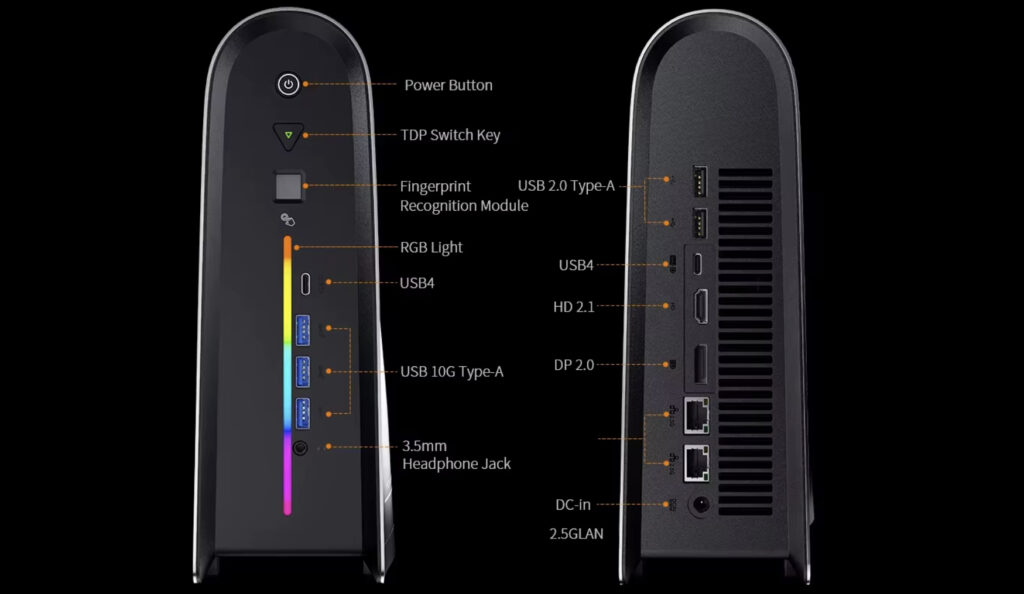

ultimateimp – High-End Mini-PC Combines Ryzen AI Max+ 395 With 160W Performance Mode. Peladn has officially unveiled the YO2, a new flagship mini-PC powered by AMD’s Strix Halo platform and designed for users seeking desktop-class performance in a compact form factor.
The new system represents a major upgrade over the company’s earlier products. Including the HO5 mini-PC based on AMD’s Strix Point architecture and the WO-4 equipped with a lower-end Ryzen processor.
At the center of the Peladn YO2 is AMD’s Ryzen AI Max+ 395 processor. One of the most powerful APUs currently available. The chip combines high-performance Zen CPU cores with the integrated Radeon 8060S graphics processor and advanced AI acceleration capabilities.
Peladn claims the YO2 can push the Ryzen AI Max+ 395 to as much as 160 watts in performance mode. Giving the mini-PC considerably more power than many competing Strix Halo systems.
The increased power budget is intended to maximize CPU and graphics performance for demanding workloads such as gaming. AI applications, content creation, and professional productivity tasks.
To sustain these power levels, Peladn has equipped the mini-PC with an advanced cooling solution featuring three cooling fans and three heat pipes.
The cooling system contributes to the device’s overall weight of 1.85 kilograms. Which is relatively heavy for a mini-PC but understandable considering the amount of high-performance hardware packed inside.
Physically, the YO2 measures 246 x 193 x 92 millimeters. Making it compact enough to fit comfortably on a desk while still offering room for robust cooling and expansion options.
Peladn is positioning the YO2 as a premium system for enthusiasts who want workstation-class performance without the size of a traditional desktop tower.
The device also joins a growing number of mini-PCs built around AMD’s Strix Halo architecture. Which has become increasingly popular among manufacturers looking to deliver powerful integrated graphics and AI capabilities.
Up to 128GB of Memory and Massive VRAM Allocation
One of the Peladn YO2’s most impressive specifications is its memory configuration. The top-end model includes 128GB of LPDDR5X memory running at speeds of 8,000 MT/s. This high-speed memory is shared between the processor and the integrated graphics system.
Remarkably, users can allocate as much as 96GB of that memory as video memory for the Radeon 8060S integrated GPU.
Such a large VRAM allocation is extremely rare in integrated graphics solutions and could provide advantages for AI models, graphics workloads, and memory-intensive applications.
The Radeon 8060S is already regarded as one of the fastest integrated GPUs available. And access to such a large memory pool could further improve its capabilities in demanding scenarios. Storage is another area where the YO2 offers considerable flexibility.
Peladn has included three M.2 2280 slots, allowing users to install multiple NVMe SSDs for expanded storage capacity and faster data access.
The company has also equipped the system with multiple connectivity ports. Although detailed specifications for those ports have yet to be fully disclosed. Currently, the Peladn YO2 is officially available only in China.
Pricing begins at CNY 21,999, which converts to approximately $3,249. The base configuration at that price includes 2TB of storage and 128GB of LPDDR5X memory.
Although Peladn has not yet announced a worldwide launch. The company has historically expanded availability of its mini-PCs to international markets.
In the meantime, the YO2 has already appeared on online marketplaces such as AliExpress, where unofficial listings place the price above $3,200.
The Peladn YO2 enters the market as one of the most powerful mini-PCs built around AMD’s Strix Halo platform. With its Ryzen AI Max+ 395 processor, 160W performance mode, triple-fan cooling system, and the ability to allocate up to 96GB of VRAM, the device targets enthusiasts and professionals who want high-end computing power in a compact package.
If Peladn eventually launches the YO2 globally, it could become a serious contender in the premium mini-PC segment, particularly among users interested in gaming, AI workloads, and content creation without relying on a dedicated graphics card.