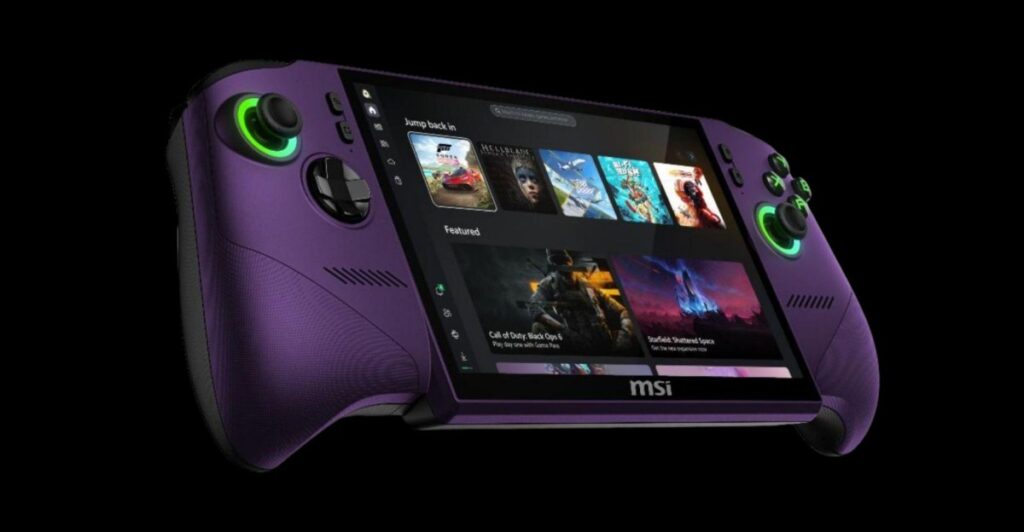

ultimateimp – New Handheld Could Challenge AMD’s Dominance in Portable Windows Gaming. MSI has unveiled the Claw 8 EX AI+, its latest handheld gaming PC powered by Intel’s new Arc G3 Extreme platform. And early impressions suggest the device could become a serious challenger to AMD’s dominance in the Windows handheld market.
The Claw 8 EX AI+ was showcased at Computex 2026 and is among the first devices to feature Intel’s Arc G3 Extreme system-on-chip. A processor designed specifically for portable gaming systems.
For years, AMD has dominated the Windows handheld segment with its Ryzen Z-series chips powering devices such as the ROG Ally and Legion Go. Intel is now attempting to change that with a dedicated handheld architecture based on its latest Panther Lake platform.
The Arc G3 and Arc G3 Extreme processors combine Intel’s Panther Lake CPU architecture with integrated Arc graphics derived from the company’s Battlemage GPU lineup.
The more powerful Arc G3 Extreme, used in the Claw 8 EX AI+. Incorporates the Arc B390 integrated GPU and serves as the flagship option for handheld gaming.
MSI’s new handheld succeeds the Lunar Lake-based Claw 8 AI+ and retains many of the features that made the previous model appealing while introducing important upgrades.
The device features an 8-inch Full HD+ display with a 120Hz refresh rate. Variable refresh rate support, and a peak brightness of 500 nits.
Although the screen specifications remain largely unchanged. The display continues to offer smooth gameplay and solid visual quality for portable gaming.
Under the hood, MSI has paired the Arc G3 Extreme with 32GB of LPDDR5X memory and a 1TB SSD.
Improved Ergonomics and Easier Storage Upgrades
Beyond the new processor, MSI has refined the physical design of the Claw 8 EX AI+. The company has redesigned the controller grips and overall shape. Making the handheld more comfortable to hold than the previous generation.
The contours of the grips resemble those found on Xbox controllers. Which are widely regarded as among the most ergonomic controllers available.
The improved design should help reduce fatigue during longer gaming sessions and enhance overall usability. MSI has also made a practical upgrade by adopting the widely used M.2 2280 SSD format.
Many handheld PCs rely on smaller SSD standards that can be difficult or expensive to replace. By switching to the more common 2280 size, MSI gives users access to a broader range of upgrade options and simplifies future storage replacements.
This decision is likely to be welcomed by enthusiasts who prefer upgrading their devices rather than replacing them entirely. Despite these improvements, the Arc G3 Extreme remains the primary attraction.
Early hands-on impressions suggest the chip could finally give Intel a realistic chance to compete directly with AMD in handheld gaming performance.
The new architecture appears to deliver impressive graphics capabilities and could become a viable alternative to AMD’s Ryzen Z series if real-world benchmarks confirm the initial results. However, one major concern remains unresolved: pricing.
Intel Panther Lake chips equipped with the Arc B390 integrated GPU are expected to be expensive. At the same time, the costs of LPDDR5X memory and high-capacity SSDs have increased significantly compared with last year.
Those factors could drive the retail price of the Claw 8 EX AI+ into premium territory. If MSI prices the device too aggressively, it could limit adoption despite the strong hardware.