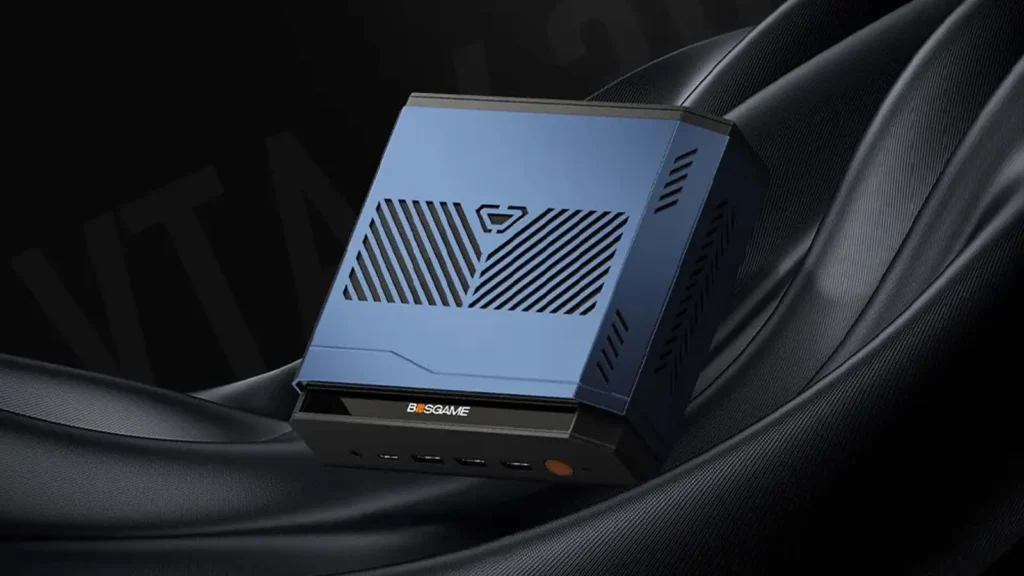

ultimateimp – Bosgame has unveiled the VTA-439, a compact mini PC designed to run artificial intelligence models and applications locally. Powered by AMD’s Ryzen AI 9 HX 470 processor, the system delivers up to 86 TOPS of AI performance and aims to reduce dependence on cloud-based AI services.
The VTA-439 targets users who want to run AI assistants, large language models, and content generation tools on their own hardware. Bosgame says local deployment can help users avoid recurring subscription fees and token-based costs associated with cloud AI platforms.
At the centre of the system is AMD’s Ryzen AI 9 HX 470 processor. The chip features 12 CPU cores and 24 threads while integrating CPU, GPU, and neural processing capabilities into a single package.
According to Bosgame, the processor provides a combined AI performance of 86 TOPS. This figure includes 55 TOPS from the dedicated neural processing unit and another 31 TOPS generated by the CPU and graphics processor.
The company claims this performance is sufficient for running large AI models and AI assistants such as OpenClaw locally. Users can also utilise the system for AI-powered image creation, video generation, and other machine learning tasks.
Memory capacity is another highlight of the VTA-439. The mini PC supports up to 256 GB of DDR5 SO-DIMM memory operating at 5600 MT/s across two memory slots.
Storage options are equally extensive. Bosgame has equipped the system with three M.2 2280 NVMe PCIe 4.0 x4 slots, allowing users to install multiple high-speed SSDs.
Based on currently available consumer drives, the mini PC can accommodate up to 6 TB of total storage. This capacity gives users room for large AI models, media files, and extensive software libraries.
The VTA-439 ships with Windows 11 and relies on AMD’s integrated Radeon 890M graphics for everyday computing and gaming workloads. Bosgame says the integrated GPU delivers performance comparable to Nvidia’s GeForce GTX 1650 laptop graphics card.
Mini PC Supports eGPU Expansion and Local AI Assistants
Although the integrated graphics are capable of handling many tasks, Bosgame has included an option for significantly more graphical power. The VTA-439 features an OCuLink PCIe 4.0 x4 interface for connecting external graphics cards.
This port allows users to attach an external GPU enclosure and pair the mini PC with high-end graphics hardware. Bosgame states that the system can support graphics cards as powerful as Nvidia’s GeForce RTX 5090.
The addition of eGPU support broadens the mini PC’s appeal beyond AI applications. Users can potentially transform the compact system into a capable gaming machine or a workstation for demanding creative tasks.
Bosgame places particular emphasis on local AI computing. The company highlights support for OpenClaw, an AI assistant platform that can run directly on the device without requiring cloud infrastructure.
Local AI execution offers several advantages, including reduced latency and improved privacy. Users also maintain greater control over their data because information remains stored and processed on their own hardware.
The VTA-439 enters a growing market for AI-focused mini PCs. Advances in neural processing units and integrated graphics have made compact systems increasingly capable of handling workloads previously reserved for larger desktops.
Bosgame is positioning the VTA-439 as a premium product but is currently offering a significant launch discount. The configuration featuring 32 GB of RAM and a 1 TB SSD carries a suggested retail price of $1,599.
However, the company is currently selling the system for $1,049 through its official website. The reduced price lowers the barrier for users interested in experimenting with local AI computing.
The combination of high memory capacity, expandable storage, and dedicated AI hardware gives the VTA-439 considerable flexibility. Support for external graphics cards further extends the device’s capabilities.
As interest in local AI continues to increase, mini PCs such as the Bosgame VTA-439 are emerging as alternatives to cloud-based services. The system offers a compact form factor while delivering enough computing power to handle demanding AI workloads and modern applications.